
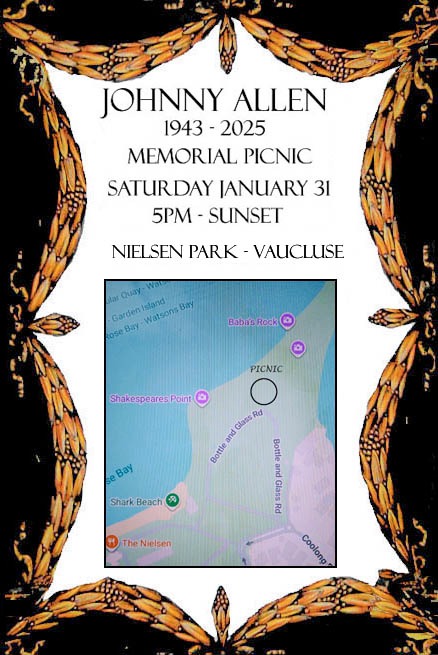
Johnny Allen was the motivating force behind some of the most exciting activity in Australia during the 1970s, from The Arts Factory to the Nimbin Festival to Cabaret Conspiracy. He will be remembered as one of the seminal figures in our culture.
Born John Kitchener Allen on June 10, 1943, in Glen Innes, New South Wales, he emerged as one of Australia’s most influential figures in counterculture and event production. Growing up in Manly, Sydney, he was drawn early to the bohemian arts scene in Kings Cross, influenced by American artists and local creative energies. After studying at the University of New South Wales, he immersed himself in theatre and alternative culture during the 1960s, editing Masque magazine in 1965 and co-founding experimental groups like The Human Condition.
His early work in radical collective theatre reflected the era’s belief in art as a tool for social change, setting the stage for his later groundbreaking contributions.In the early 1970s, Allen became a pivotal force in Australia’s countercultural movement as co-director of the Aquarius Festivals, organised by the Australian Union of Students. He collaborated closely with Graeme Dunstan to stage the landmark 1973 Nimbin Aquarius Festival, held from May 12–23 in rural New South Wales.
This ten-day event, envisioned as an “art form” itself, drew thousands seeking alternative lifestyles, sustainability, and communal living. It transformed the quiet town of Nimbin into a lasting hub for hippie culture, ecology, and progressive ideals, widely regarded as the birthplace of Australia’s counterculture. Allen’s vision helped shift focus from urban protests to positive, community-oriented experimentation.
Even in later years, he remained connected to his legacy, attending the 50th anniversary commemorations of the 1973 Aquarius Festival in Nimbin in May 2023.
Johnny Allen passed away peacefully at home on December 22, 2025, at age 82, surrounded by friends and carers after a long illness. His life embodied the spirit of transformation and collective creativity that defined Australia’s countercultural era.
Here is an extended interview conducted by John Stapleton circa 1980.
JOHNNY ALLEN
We are sitting in the Suddenly Last Summer courtyard of the large old stone house that he lives in with a number of other people in inner-Sydney. It is about half past one in the morning. Armed with a flagon of wine and a cap of hash oil we forge cheerfully into nostalgia.
JS: What were you doing in the late sixties?
JA: Finishing off a drama degree at Sydney Uni, getting involved in all sorts of alternative theatre.
JS: What was the atmosphere of that time?
JA: For me it was a very heady one of really feeling that pretty enormous changes were taking place, that a small group of people who had zapped into acid and mind expanding drugs of one kind or another and stepped out of all the structures…
JS: Did you realise that it was only a small group?
JA: Yes, very much so, because in Sydney it was very visible. Like at one point in time I think I knew everyone in Sydney who was taking acid just about. Now you assume if you meet someone under 25 or under 30 they’re probably into acid and dope. Then you knew most of the people in town. It had a very small and rather special feeling about it. So did the art scene. The few people that were that up and coming generation, the Richard Nevilles and the Martin Sharps were very visible. It felt like a close knit community which it’s lost since and that’s been both a loss and a gain. It’s been an expansion out. I always think about it as if you take a drop of blood or ink and drop it into a bowl of water the blood red turns pink and that’s what I think has happened. A vast number of people absorbed all those insights and flashes of the sixties but the force of them has diminished as they’ve spread out.
JS: What has happened to those people you knew then?
JA: It’s hard to generalise. Some of them have settled into making careers out of what they do and I think kind of lost a lot of the contact and power that they had. Others have just gone much more deeply into what they do and now do it very finely and very well. The people I appreciate are those who over that ten years have really gone very deeply into the craft of what they do. I think Martin Sharp is a good example. An incredibly fine craftsman and artist at what he does. Jeannie Lewis who I think has got better and better. Brett Whitely; a whole set of artists you can see maturing and they are the great artists of this period. They were visible ten years ago and are even more visible now.
The ones who’ve got lost in careers I’d rather not go into the details of. There are quite a few people that I now feel very estranged from. They’re acknowledged and they’re good at what they do but they don’t seem to me to have really moved on much in their own personal lives.
JS: What do you think the chemical acid has done to our society?
JA: I think originally it had an incredible impact in terms of some of the insights that it did open up. One of the things that I think has been glossed over is that the original Sandoz acid which hasn’t been available for a very long time was incredibly more powerful than anything that’s around now. When you took trips in 1968 you literally did see flights of descending angels and you literally did have whole earth consciousness flashes. I don’t get those on acid now and I don’t think most people do.
I think it’s marginally more pleasant to live on the planet now than it was ten years ago, just marginally. People are marginally more tolerant, more liberal. It seems to me that the possibilities that 1979 offers me are much greater than the possibilities that 1969 offered me in terms of personal freedom to be myself and to live the way I live. And that’s got to do with the effect that all that has had on society.
JS: Can you describe the scene that existed in Sydney in 1969?
JA: It was a very genuine bohemia I think. There were little groups of people centred around little explosions like the Yellow House and the Arts Factory and the White Company and Arimba and Nimbin and those sets of things which were incredibly powerful gatherings of people, people with enormous skills and talents and insights. It had the feeling of genuine bohemia, that is a section of the society with powerful communal and powerful creative mechanisms as it were.
I’d been working all my life from an insurance clerk to a university student to a teacher and the first day I realised that I could in fact give up my job and get by quite well and just do what I wanted to do was an incredible liberation. I suppose now most kids have that liberation at 13 and drop out of school as soon as they can but then if you didn’t have a job there was no way of accommodating that in your mind. That was a big change. People’s attitudes have changed. More people expect to enjoy their lives. In the fifties you thought of a job as being a necessary selling off of your time. You didn’t expect to enjoy it.
JS: Most people still don’t expect to enjoy their working lives.
JA: I think that’s true but huge numbers of young kids on the dole now get around to figuring out that life on the dole is not necessarily the end. Life on the dole offers you a lot of freedom to explore and there are literally thousands and thousands of kids doing that now whereas in 1960 I didn’t know one.JS: Yet the media image of the life of the unemployed is pretty dismal.
JA: I think it’s entirely dependent on the attitude that you come to it with. If you come to it with the attitude that you want to work in a straight job and you’re being deprived I think it is very very dismal, very down heartening. If you come to it with the attitude that who needs jobs in white collar industrial society anyway then it simply opens up a lot of possibilities. Some people get by on the dole really incredibly well and some people are really put down by it according to how they’ve been able to think it out.
JS: Do you think that the high unemployment rate that exists now is liberating a lot of people into being able to use their time in a different manner to do different things?
JA: Yes I think it certainly is. I think we’re heading towards a society where a lot of people are going to be unemployed a lot of the time. The solution to that society is learning to manage yourself. It’s not going to be possible for all of the population to be involved in the physical day to day getting together of their lives, a lot of people are going to be free to explore their own creativity. It’s leading to a type of renaissance. Sydney is beginning to feel like a buzzy metropolis with a lot happening. I quite often think that in the 80s we’re going to be one of the really creative cities of the world. Sydney feels to me right up with the most interesting cities in the world, there’s a lot going on that’s really good.
JS: Atmospherics?
JA: It was a very euphoric period that came to an abrupt conclusion on 11 November 1975. I think it went right through to ’75. My major involvement in that period was with Nimbin which felt like a continuation of that, a very euphoric let’s try everything let’s think of the weirdest and most wonderful possibilities and try them.JS: Can you describe the events that led up to Nimbin?
JA: Things like Nimbin are the public expression of things that have happened at a much more private level. To me the essence of Nimbin really was a small festival done at Ourimbah outside Sydney which was done as a response to the big Woodstock style commercial rock festivals when about 500 people said ok let’s do a festival not to make money but just to do our own thing and it was an Easter festival that went for seven days called The 7 days of creation which was a very big contrast to those big rock festivals. It just broke all that apart and reduced it to a very creative very communicative scene. That was a huge influence on me. I was deeply involved in that festival because I was running the Arts Factory and it was basically a musicians’ festival. We just all went to the country for Easter basically. And very shortly after that I met up with Graeme Dunstan who was editor of Tharunka at the time and who wrote a piece in Tharunka about that festival and very shortly after that the Australian Union of Students advertised for a festival director and cultural director so we got together and thought well…
It was intended when we stepped into it to be held on the Melbourne University campus but what is the point of doing yet another arts festival on a university campus with all those plays and all those concerts in amphitheatres. It doesn’t really amount to anything. So we worked very hard to transfer the thinking around to an Ourimbah style mass gathering in the country exploring alternative lifestyles. Very naively. There was a lot of just absolutely naïve buoyant optimism with the Nimbin thing.
The whole concept of what we wanted to do with the festival could only have happened in a country environment and it was part of that moving back to the country. We chose Nimbin because it seemed logically that the point in Australia that was able to be settled fairly easily was the North Coast.
The farming thing had fallen apart and land and houses in the country were cheap. Climate was easy to deal with. It was very easy to tackle the land and farm it. It’s very unique when a large number of people from a different cross section of areas can come together harmoniously. They are very unique points in time when that can happen on a large level.
The differences between people are usually so great that once the differences become visible you’ve just got to opt for what I think the eighties are going to be about which is just tolerance of your neighbours’ differences.
Just occasionally there are magic mechanisms and magic points in time when people can forget those differences and just concentrate on equalities which are great periods. That was what Nimbin was about, that’s what Cabaret has been about. But I think they are always short lived periods.
You get people living next door to one another now whose outlook on life and their lifestyles are so different that they may as well be in different time spaces and in different countries yet they live happily next door to each other with two walls of brick between them. It’s weird. In most periods of history there’s been a kind of general thing that’s held the society together but that’s not happening so much anymore. Australia is particularly like that.
JA: I think we’ve reached that point where we just have to accept the pluralist society. There’s no agreement about anything and all any government can do is hope to satisfy as many bits of that puzzle as they possibly can.
When I look back on it now I feel a certain strangeness to Nimbin and some of the ideas. I think some of the things we were talking about in 1972 were dead ends although some of them, almost like prophecies, have come true.
We set about to recycle the town and we did it quite effectively and that idea then would have been quite foreign to the idea of centralisation. The idea then was that you built a town or you built a city then you gave it an industry to thrive off. You didn’t do it at that grass roots level of resettling the land and I think since then it’s become a fairly massive movement. There’s quite a marked population shift now back to the country. It’s a small percentage but it’s enough to be a marked shift and I think a lot of the things we talked about then like voluntary poverty and voluntary unemployment that some people were going to have to be unemployed so those people are going to be the ones who will be carrying out the most interesting survival experiments.
I think a lot of that was breaking new ground in 1972 and I think it’s now becoming a part of the accepted thinking of the bureaucracies. It’s interesting that they don’t hassle people on the dole on the North Coast a lot because they know darn well those people are doing something pretty viable and they’re doing it the only way it’s possible for them to do and in the cities they would just join the ranks of the unemployed and probably be living far less creative and happy lives.
I think increasingly the whole thing of the dole bludger is going to fall away as people realise it’s just not practicable. The communal experiments that were going on then have been absorbed a lot now. The idea of knocking down your suburban back yards and food co-ops and all of that thing has spread very much more widely. It’s been watered down but it’s had a very visible effect.
The urban communes that interest me are the ones where people live together because they have some kind of artistic or work cohesion between them, the kind of warehouse arts group thing. I think it’s going to be an increasing pattern in cities and it’s a very satisfactory answer to living in the city to live in interesting spaces that give you workshop possibilities or performing possibilities and give you an interesting kind of context to live in.
I think that’s part of the excitement of living in cities now is there is a lot of experiment going on with the nature of living together and the nature of creating together and I think they’re pointers for the future, again multiplied many times.
Nimbin was many different things to many different people. For some people it was ten days of complete euphoria. To me a lot of it was ten days sitting in an office listening to people’s complaints ranging from why aren’t there taps next to my tent to I broke my shoe outside and can you fix it at three o’clock in the morning. And being conscious of the ripoffs and being conscious of the negatives, you see the negative side of it a lot. Like if you set up a donation based trusting food co-op there’s always going to be someone who’s going to rip $50 off out of the till or walk out and expect not to pay.
Energy ripoffs largely, people expecting to take without realising that it’s a spiral and if you take it out somewhere you’ve got to put it back somewhere else or the whole thing falls apart. That’s a negative way of looking at it but that’s the bit you’re forced to look at if you’re involved in trying to hold something like that together. I came away from Nimbin thinking I wish someone would do a Nimbin so I could just go along and visit rather than having to be involved.
JS: What has happened in the Nimbin area since then?
JA: There were lots of problems initially. One of the problems was that when 25,000 people came together at Nimbin over about 10 days a lot of them highly creative highly energetic in the way they approach things when it’s over most of them who have got anything substantial that they’ve come from have got that to go back to and go back to doing what they were doing and the ones who were around the edges of that the ones who were attracted by the energy of others just hang there because they came from nothing and they’ve got nothing to go back to. Originally there was a lot of that sorting out but gradually a lot of strong people have emerged from that or have gone up there and I think there has for some time now been a very solid community up there.
The big change for me has been… I lived back at Nimbin for a few years after the festival and then I went from there straight to the States and for the last four to five years I’ve lived almost exclusively in big metropolitan cities, really big ones like Tokyo, Paris, New York and London and Sydney and I’ve accustomed myself to an urban lifestyle and enjoy it. I’m not terribly interested personally in the country style of living although I see it as a very real thing and something that I might participate in again sometime but I’m much more interested in the creativity inside big cities. So in a sense that’s separated me…
JS: Can you talk more about what it was like to be at Nimbin during the festival?
JA: It’s one of those things where anything you can say about it sounds like a platitude. For the first several days the love and commonality between people was almost tangible, you walked around and it was a thing you could almost physically feel. A very different way of relating in mass numbers to anything that I had ever experienced before. Then it went through several stages. The drug busts and the politics and the riots with the cops etc. changed it all. It was like a huge piece of theatre with a cast of thousands and a very interesting plot line and interesting side plots when you knew what forces had brought it about.
I think when you get a large number of people together in anything except artificial situations you get an enormous amount of energy unleashed which has always got positive sides to it and negative sides to it and the stronger that collision of energies then the stronger both the positives and negatives will be. And Nimbin was a blowout. It was a huge whack of both. A huge positive and a real bummer. It exhausted me. By the end of it I was totally physically and mentally exhausted.
I think it was a really unique event. When I went to the States and questioned people about what the counterparts had been…
I think there was only one Nimbin. I don’t think anything like that on that level (continuing) …happened in the States really. Woodstock wasn’t that. It was a unique thing. It could only have happened with a very gratuitous set of circumstances. It couldn’t have happened without the Whitlam government in power and the kind of euphoria that that brought about. At that point you really could walk into Tom Uren’s office or whatever and sit down and have a chat about how you thought urban planning ought to go or forestry or whatever your thing was. It felt like government was accessible, that government was thinking through some real problems in a novel way and there was that feeling that vast changes just might happen.
That festival couldn’t have happened without all that background and it couldn’t have happened at any other time. It was a very high point of an era which as I said came to an end very abruptly with the end of the Whitlam government which I think was a tragic thing for Australia.
What happened for me was immediately the Labour government went out I split. I just decided I was no longer interested in living in Australia for a while and I was away for eighteen months. When I came back after having lived in San Francisco and big buzzy cities Sydney felt like it was in a state of shell shock. I came back and I couldn’t believe three million people lived in this city, couldn’t believe that so few signs of urban life and creativity were going on. It’s changed now but I think it did go through an incredible shock period at the loss of all that.
I think we’ve got back to being a very buzzy creative city again here and maybe getting back to where we left off at the end of the Whitlam government but it’s taken four or five years to overcome that.
JS: Why was it all cut off?
JA: A hard one to answer. I think it’s just that generally people can’t adapt to changes too fast, when that positive exploratory energy is released it’s exhausting and there comes a point…JS: I don’t see why it should reach that point…
I see that because that’s the way I work. I’ve accepted in my life that I can only really work on projects because when something turns me on it’s always because it’s a certain set of circumstances that I can apply my energies to because my talents are very peculiar.
My creativity for what it is is very much based on movements and cultural history and other people and there are times when that’s cut off from me and times when there’s literally nothing I can get involved in so I just go lie on the beach or go and do a straight job and travel and there are times when the social conditions are such that I can step in and put those energies to use because I know a little bit about bringing the energies of other people together and that’s a very peculiar sort of profession. Then I find what I do is jump into that and I go full bore until it gets to a point where it exhausts itself because I don’t think you can live on that level of energy for vast periods of time and pour the energy out. There is a point…
JS: Do you see such a thing as an alternative or counter culture existing in Australia?
JA: They are words I hardly use anymore. I think it’s largely been absorbed. The mainstreams grown closer to it or vice versa. I think it’s just shifted on.
There were always those rare bohemians. I think there is a tradition of bohemian culture in Australia that seems to me to go right back to the 1880’s but somewhere around the sixties that exploded. I look back on those people as the ancestors of what we’ve inherited. The pity about it is because we’ve been raised in a sort of cultural imperialism we weren’t made aware of our own ancestry. We were taught to regard Kerouac and Ginsberg and Allan Watts and whatever as being the bohemian tradition and we weren’t taught to regard our own bohemian tradition.
Those people in the States died as fairly famous poets or writers. Ours usually died in the gutter with alcohol poisoning or in old age homes totally unknown.
One of the good things about Australia is there are certain unifying things… the physical nature of the climate. I find Sydney wonderful that you can go and lie on the beach and lie with this incredible amazingly diverse group of people and you can all enjoy the one thing i.e. lying on the sand watching the waves and looking at the sky together. If you had to sit down and talk to some of those people you might want to run a mile but it’s got these terrific unifying things. I think that physical climate thing has an enormous influence on Australians. It makes them incredibly physical easy going people. I think it’s a very pleasant race of people.
Sydney was much more violent ten years ago than it is now. I used to be genuinely sceptical about moving around the back streets of Kings Cross 10 years ago but now I wouldn’t give it a second thought. I have no feeling of violence from the streets. I find it an incredibly peaceful city to live in. The potential for a New York style of violence is here. There is a lot of real poverty and real frustration and real negativity in Darlinghurst. The number of people I know who have overdosed or suicided or been bumped off in the last year is quite considerable but that violence doesn’t impinge on you in the streets.
JS: How do you feel about seeing your friends drop off?
JA: Over the years I’ve learnt that there are the survivors and the non-survivors. Some people are going to survive and some are not. You can only see community as people that you want to survive with. Some people seem to be very vulnerable. You can tell. Quite often you can see ahead of time that someone’s going to go under, they’re not going to survive.
JS: Isn’t that peculiar to our period, to see so many of your friends go that way?
JA: I said earlier that I think we’ve inherited that bohemia and hasn’t it always been one of the characteristics of bohemian society… Surely the careers of Byron and Shelley and Rimbaud and Verlaine and Baudelaire… So many of those people died of violence or disease or insanity ridden deaths at 18 or 20, the whole romantic tradition.
I think that’s always been true of groups of people who live extreme lives and that’s becoming the norm for more and more people as the world gets freakier and freakier. Everything is speeding up. Sometimes it seems like we’re on a giant roller coaster which is going faster and faster as it careers downhill and I sometimes do get this feeling that we do live at the tail end of a civilisation.
If that’s true and very often I do think that it is true then there is nothing that we can do about the fact that that civilisation is going to explode. American western capitalist society as we know it and as we’re a part of is obviously falling apart and doesn’t have much longer to last in this form.
We’re going to be very lucky if we pull through unscathed. Nobody’s going to be terribly surprised if they pick up a paper tomorrow and learn that the US has invaded Iran and the whole thing was on. You wouldn’t really be all that surprised. There’s almost that feeling that there’s a continual sunset and a gathering storm which you continually expect to break.
Ten years ago there were small groups of eccentric people talking about the economic collapse and the fall of the whole thing. Now you almost expect to open page 2 of the Financial Times and read about it. But as it gets closer to it it seems very scary. I think we have to be prepared in our lifetime to bury our heads in the sand and just last it out while times are really heavy. For some people that’s already a state of existence.It feels like that in big cities. It felt like that in New York, like boy the whole thing was right on the edge but that’s that roller coaster feeling of excitement too.
It’s a very exciting period to be living in now. The late sixties early seventies was a very expansive optimistic hedonistic period, now is a very exciting decadent and scary but very exciting time to live in. It’s really moving fast.
The thing that interests me in the culture at the moment is that kind of communicative buzz and that decadence tends to be away from it.
I find the decadence interesting but I think boy it’s got real limits, there’s so far you can go with it and you’re up against a brick wall. It is very nihilistic. Like the punk thing which very quickly had nowhere to go except to be absorbed by the mainstream and broaden out.
I think increasingly all the individual can do is opt for anarchy and control over your own space. You’re a survivor and you’ve got your act together and say fuck it to the mega systems because none of the mega systems are going to work.
JS: You don’t feel any revolutionary zeal to change the whole?
JA: I don’t think it’s open to you to influence the larger whole. I suppose I’ve been involved in a fair number of fairly mass events in my lifetime but I really feel that my ability to influence mega systems out there is almost zero, it may as well be totally zero. But my ability to change my own life and interact with a few people around me and change theirs is considerable and that interests me much more. It’s much more tangible. I can’t imagine anything more awful than to be a politician, constantly having to deal in abstracts.
I’m very optimistic about the world at the level of interaction between people and the level of personal politics and I’m very negative about the world in terms of the mega. I find it increasingly impossible to trust governments of large countries and trust the forces that work on that mega level. I think the lesson from Nimbin was to think small.
I did it that once but I don’t think I would ever again be involved in a gathering of 25,000 people. I’m now far more interested in my own block, far more interested in small groups of people achieving things at a certain depth. It seems the larger things get the more out of control they get and the less they’re able to include peoples personal realities. It was a necessary experiment, but…